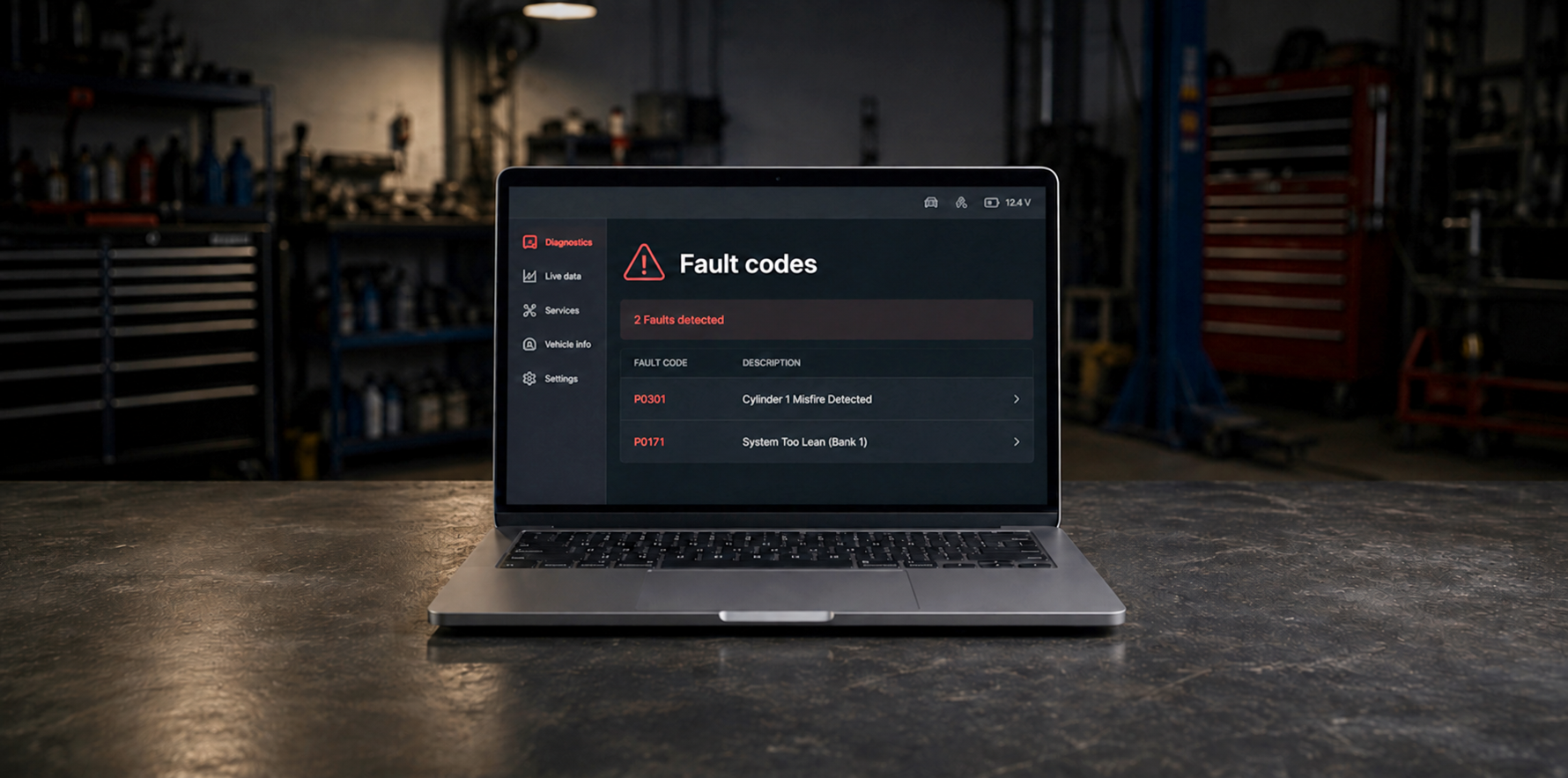



Fault Codes Read
Mochester App Fault Codes Read solutions for:
How to get
1. Select a Service
Check available tuning solutions in the Mochester App for your truck.
2. Pay for Your Order
Top up your wallet on https://dl.ge/ for the amount of the chosen solutions.
3. Get Your Solution
Return to the Mochester App and get the solutions.




15+ Years of Experience
Professional ECU programming for commercial vehicles since 2009.

Official DrunkLab Software
Original engineering solutions developed by the DrunkLab team.

Fast Turnaround
Most tuning sessions are completed in 25 minutes or less.

How to use the Mochester App
Download
Install and launch the Mochester App. Sign in using your dl.ge account and click Login.
Connect
Tap Start Connecting, follow the on-screen steps, and wait while your vehicle is identified. Click Next to load available tuning solutions.
Top-Up
On dl.ge, open Wallet, select WALLET TOP-UP, enter the required amount, complete the payment, then return to the Mochester App.
Proceed to tuning
Select one or more tuning solutions, click Next, confirm with your one-time password, and wait while the download completes and flashing starts automatically.
Processing
Wait until flashing is complete while monitoring the progress bar. A detailed report will be generated, and your selected features will be ready to use.
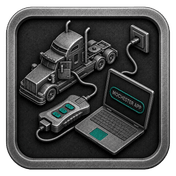
What are truck fault codes and how can the Mochester App read them?
Truck fault codes, also known as DTCs (Diagnostic Trouble Codes), are diagnostic messages generated by the vehicle's electronic control modules when a fault is detected. Mochester App (M4 App) allows users to read fault codes from supported Volvo, Mack, Renault, UD trucks, Volvo CE equipment, Volvo Penta engines, and buses, helping identify engine, transmission, emissions, electrical, and communication system problems quickly and accurately.
Modern trucks are becoming more complex and sophisticated, what makes their maintenance more difficult than before. The trucking industry has established a standardized truck fault code system that allows mechanics to accurately diagnose and fix problems.
Diagnostic equipment for commercial vehicles is a special class of professional car scanners used by large service centers and auto repair shops. This equipment class focuses on truck scanners. Today, these trucks have scanners which, compared to passenger cars, have almost more ECUs.
With our Mochester App, you can read the errors of most Mack/Volvo/Renault/UD trucks and buses for free, as well as Volvo CE and Volvo Penta 2004 and newer.
What are truck DTC (Diagnostic Trouble Codes)?
Mechanics used to look under the truck’s hood to see what was wrong to fix the problem. However, as more and more companies have integrated intricate computers and electronics into the truck design, it has become much more difficult to diagnose problems by eye.
The solution to this problem was the trucks DTC. Truck Fault Codes, or Diagnostic Trouble Codes (DTCs), were first introduced in 2009 and represent a standardized method for reporting and diagnosing truck problems. The purpose of creating a truck fault code reader was to find an easy way to identify problems with truck systems that need to be repaired.
How do truck fault codes work?
Each truck diagnostic fault code corresponds to a specific problem. Modern trucks are equipped with sensors that monitor EGR, DPF, SCR and other truck components and monitor their operation. If the sensor detects a problem, it sends a signal to the engine control module, which activates the warning light on the dashboard.
All cars in the United States since 1996 have reported diagnostic problems using the J1939 or OBD-II codes. The current standard DTC code for heavy vehicles is J1939, while the OBD-II is standard for passenger cars. Mechanics use a special tool to interact with the vehicle's engine control module to identify DTC codes and identify problems.
Conclusions:
DTC codes are used to diagnose vehicle malfunctions. Sometimes they can be minor, for example, a loosely fitting fuel tank cap, or more serious, for example, a faulty oxygen sensor. If an engine fault code is triggered in your truck, it is important that you know what this DTC code means.
It is hard to overestimate the importance of reading DTC for the operation of a modern fleet. The ability to read fault codes will help you to maintain your trucks, buses or CE in excellent working condition. Access to truck diagnostics allows you to accurately diagnose problems and always be aware of maintenance needs. And the easiest way is to use our Mochester App (M4 App) with a free solution to read fault codes of your truck.
Types of fault codes
Modern cars use two types of truck fault codes: critical and non-critical.
Critical codes. These include fault codes that can cause serious damage. Such problems as a coolant leak or high engine temperature are critical issues because they can cause permanent engine damage.
Non-critical codes. These include fault codes which cause though not imminent dangerous problems, but nevertheless require immediate attention. Non-critical fault codes include such problems as high emissions, low tire pressure, or contamination of air filters.
The Suspect Parameter Number (SPN)
The first number represents the number of the suspicious parameter and indicates which system has the problem. The current J1939 protocols reserve a 19-bit number for SPN identification in the range from 0 to 524287. This level of specificity allows you to find out which system has a problem.
The Failure Mode Identifier (FMI)
The failure mode identifier indicates a specific problem. For example, an FMI of 4 indicates that the voltage is below normal. Modern J1939 standards have 22 different failure mode identifiers, which present problems ranging from incorrect calibration and mechanical failure to high currents.
The FMI identifies the kind of error that has occurred. For example, FMI may signal an issue with the electrics.
The following is a list of FMIs:
0 - Highest
1 - Low
2 - Intermittent
3 - High Voltage
4 - Low Voltage
5 - Open Circuit Fault
6 - Ground Short
7 - System not responding
8 - Frequency abnormality
9 - Update that is out of the normal
10 - Rate of Change out of normal
11 - Other failures
12 - Complete failure
13 - Calibration out
14 - Special instructions
15 - Data valid but above the normal range
16 - Data valid but moderate-severe range
17 - Data valid but below not severe range
18 - Data valid but below moderate-severe range
19 - Network data error
20 - High drifted data
21 - Low drifted data
31 - Existing condition
Occurrence Counter (OC)
The number of occurrences shows how many times the problem occurred. The more often the engine control module detects a malfunction, the higher this number is.
SPN Conversion Method (CM)
DTC CM is a short number that defines how to convert SPN and FMI to identify a specific problem. Older trucks using the J1939 standard have three conversion methods, while modern heavy vehicles use the fourth.
Example of a truck fault code
Now that you understand the basic components of a DTC, let's look at an example of a DTC to illustrate how to read them. Let's say you have diagnosed your truck and received the code P0503.
In this case, the letter "P" indicates your transmission as the main culprit, "05" indicates that the problem is related to the speed sensor, and "03" indicates that the sensor voltage is too high. Please note that your truck may use additional codes, so for more information about manufacturer-specific codes, refer to the manufacturer's instructions.
Considering how many things can go wrong with your truck, the J1939 fault codes can be complicated. Mechanics use special code readers which interact with the truck's nine-pin J1939 connector to translate codes into an easy-to-read format.
Common Truck Fault Codes
Below is a list of some of the most common fault codes and their meanings.
● P0101 indicates a malfunction of the mass air flow sensor.
● P0442 indicates a malfunction of the vapor emission control system.
● P0030 indicates a problem with the heater control circuit.
● P0606 indicates a malfunction of the powertrain control module.
● P0706 indicates a malfunction of the transmission range sensor.
● P0703 indicates a problem with the voltage of the switch circuit.
● P0110 indicates a problem with the air intake sensor.
FAQ
What are some common reasons for fault codes in trucks?
Common reasons for fault codes include sensor malfunctions, electrical issues, engine or transmission problems, exhaust system faults, and communication errors within the vehicle's onboard systems.
What do different fault codes signify?
Sensor malfunctions, electrical issues, problems with engine or transmission, failure of the exhaust system, communication errors in the onboard vehicle systems.
How often should I check for fault codes in my truck?
Regularly scheduled diagnostic scans help uncover fault codes in vehicles. Routine diagnostic scans should be scheduled every time there’s a maintenance check or noticeable problem with the vehicle.
Can reading fault codes help improve my truck's performance?
Yes! Your truck can be better if the problems the fault codes tell you about are fixed. Each system resolves and works better when the problems are fixed. Problems that are not fixed can get worse and affect the overall better working condition of your truck. Problems should be fixed so the truck systems perform with the best functionality.
Can I read truck fault codes without visiting a dealership?
Yes. Using the Mochester App (M4 App) and a compatible diagnostic adapter, supported vehicles can be scanned without visiting a dealer or repair facility.
What is the difference between a fault code and a warning light?
A warning light simply indicates that a problem exists. A fault code provides detailed diagnostic information that helps identify the specific system or component involved.
What are SPN and FMI fault codes?
A FMI (Failure Mode Identifier) describes a type of failure and a SPN (Suspect Parameter Number) indicates the component or system where the failure exists.
Can fault codes be active or inactive?
Yes. Active fault codes indicate a current problem, while inactive codes represent faults that occurred previously but may no longer be present.
Can fault codes cause engine derates?
Yes. Active fault codes show existing issues. Inactive fault codes show an issue that once occurred, and is possibly resolved.
How often should a fleet perform diagnostic scans?
Many fleet operators perform diagnostic scans during scheduled maintenance intervals and whenever a warning light or performance issue appears.
Can fault code reading help prevent expensive repairs?
Absolutely. Catching issues early means you can fix the problem before you have a component fail, breakdown on the road, or a big expense due to equipment being out of service.
Which systems can generate fault codes?
Fault codes can be generated by engine, transmission, braking, ABS, aftertreatment, dashboard, body, and electrical module systems. Furthermore, fault codes can be generated by steering and communication systems.
Which truck brands are supported for fault code reading?
The Mochester App allows for fault code diagnostics of provides Volvo, Mack, Renault Trucks, UD Trucks, Volvo Buses, Volvo Construction Equipment, and Volvo Penta on supported platforms.